Troubleshooting · refrigerators · cooling
Refrigerator not cooling in Burnsville: what to rule out first
The freezer seems fine, yet the milk is lukewarm and the butter has gone soft. That pattern narrows the suspects quickly, and a Burnsville homeowner can rule out several of them before our technician pulls into the driveway.
- $89 diagnostic, counted inside the repair you approve
- One written price before any work begins
- Monday through Saturday, same-day when we can
- Safe range37 to 40°F fresh food, 0°F freezer
- PriorityA warming refrigerator moves up the schedule
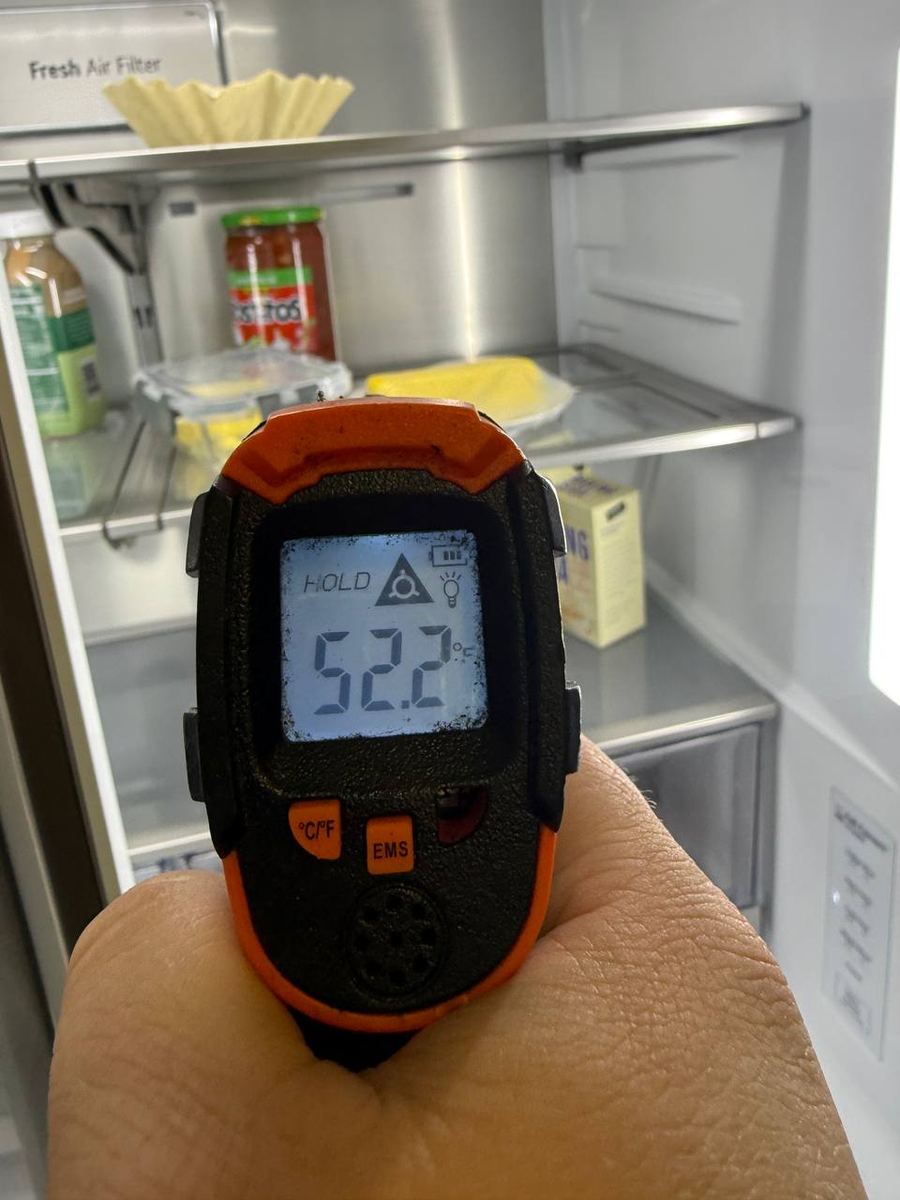
- Our toolsMeter and infrared thermometer before any verdict
Safe checks first
Six safe checks for a warm refrigerator
- Look at the temperature control; a bumped dial or a display left in showroom mode can stop cooling entirely.
- Run a hand around each door gasket and make sure a pan, drawer or tall bottle is not propping a door open.
- Clear the vents inside both compartments; crammed shelves choke the chilled air that crosses over between the two sections.
- Vacuum the dust off the toe grille at the bottom front; a matted grille starves the condenser of air.
- If the interior light is dark as well, plug a lamp into that outlet, then look at the breaker panel.
- Leave a glass of water on a middle shelf overnight and read it with a kitchen thermometer; that number helps the diagnosis.
Likely causes
Common causes of a warm refrigerator and how each is confirmed
| Likely cause | What points to it | What the technician tests |
|---|---|---|
| Defrost failure icing over the evaporator | Freezer roughly fine, fresh food warm, heavy frost behind the rear freezer panel | Defrost heater and thermostat continuity, defrost control, frost pattern on the coil |
| Evaporator fan motor stopped | Little or no air from the freezer vents; chirping or silence | Fan voltage and motor resistance, door switch pressed so the fan should run |
| Condenser fan or dusty condenser coils | Compressor runs nonstop, cabinet bottom hot, both sections drifting warm | Infrared reading across the condenser, fan motor check, compressor amperage |
| Stuck damper or failed thermistor | Freezer cold, fresh food warm on a bottom-freezer or French-door model | Thermistor resistance against temperature, damper motor operation, control outputs |
| Start relay, overload or compressor | Clicking every few minutes, compressor hot to the touch but silent | Relay and overload continuity, compressor winding resistance and amperage draw |
How it works
Where the cold comes from, and how it travels
A refrigerator does not make cold; it moves heat out of the cabinet. The compressor pumps refrigerant through the condenser coils near the floor, where heat from your food escapes into the kitchen, and then into the evaporator coil hidden behind the rear freezer panel, where the refrigerant boils and pulls heat out of the air. A small fan draws cabinet air across that frozen coil and pushes it back out through the freezer vents. In most top-freezer, bottom-freezer and French-door designs, a duct or a motorized damper meters part of that air into the fresh-food section, so the fresh-food side depends entirely on the freezer coil and its fan. Several times a day the control pauses cooling and runs a defrost heater to clear frost from the coil.
Most warm-refrigerator calls trace back to air rather than refrigerant. When defrost stops working, whether from an open heater, a failed bimetal thermostat or a control that never starts the cycle, frost keeps stacking up until the coil looks packed in snow and the fan has nothing to push air through. Fan motor bearings wear until the fan slows or seizes. Dusty condenser coils keep the compressor laboring through long, hot run times, and the start relay and condenser fan wear out early as a result. A leaky gasket lets humid kitchen air in, and that moisture turns to frost. If all of those test good and the coil still will not chill, the trouble may sit in the sealed system; the technician then walks you through the numbers and what they mean for fixing versus replacing.
Minnesota angle
Burnsville summers, garage units and power interruptions
Burnsville refrigerators work hardest on the dozen or so days a year that reach 90°F, when humid air rushes in at every door opening and the condenser has to shed heat into a warm room. Garage and basement units face the opposite problem. In January the thermostat inside a garage unit feels a frigid room, asks for almost no cooling, and the frozen food above or below it softens. Burnsville's water, about 23 to 25 grains per gallon, clogs dispensers and ice makers more than it affects cooling. Outages matter too; after one like the overnight tornadoes of September 2021 near Highway 13 and Cliff Road, a control board or start relay does not always restart cleanly.
When to call
When to stop checking and book a technician
Book a visit if a glass of water on the middle shelf still reads above 40°F a day after the controls, vents and gaskets check out, if frost blankets the freezer's rear panel, or if you hear clicking from the bottom of the cabinet every few minutes. Move perishables to a cooler with ice first. Say yes to the repair and the $89 is already inside its price; pick a new refrigerator instead and that $89 visit is all you spend.
Book online · up to $15 offQuestions
Refrigerator not cooling: questions
Why is my freezer cold but the refrigerator section warm?
That split nearly always points to airflow between the two sections. The cold is produced at the freezer coil, and a fan pushes it into the fresh-food side through a duct or damper. A frosted coil, a stalled fan or a stuck damper starves the fresh-food side first, even though ice cream next door stays hard. The technician opens the rear freezer panel, reads the coil with an infrared thermometer and tests each part on the meter.
My refrigerator clicks every few minutes and is getting warm. What is going on?
That rhythm usually means the compressor keeps attempting a start and a protective overload keeps tripping it. Suspects include a failed start relay, a tired overload, a condenser fan that quit and let things overheat, or a compressor that is locked or electrically open. Unplugging and replugging only repeats the cycle. Our technician puts a meter on the relay, the overload and each compressor winding and reads the amperage draw before naming a part.
How quickly can a technician reach a warm refrigerator in Burnsville?
Calls that come in early often get a same-day slot, because a cabinet that is losing cold goes ahead of routine work, Monday through Saturday. Phone us or fill in the booking form, which trims up to $15 off the repair price. The model number is printed on a label along a fresh-food wall or ceiling; read it to us. We ring back with a two-hour window for the technician's arrival.
Does it make sense to fix a refrigerator that quit cooling?
In most cases it does, since fans, defrost parts, relays and sensors cost far less to replace than a new unit plus delivery and haul-away. If the readings lead to the sealed system, the technician explains what that means on an older refrigerator so you can weigh replacement. And if the original maker's coverage still applies, you hear about it first, before we quote a single repair.
Every January my garage refrigerator stops keeping food cold. Is something wrong with it?
Possibly not. Many refrigerators sense temperature only on the fresh-food side, so when a garage nears freezing, the control sees no need to run, and the freezer compartment warms with it. A few models carry a garage rating or take an add-on heater kit, as the owner's manual will say. If it stays warm after a thaw, or it sits somewhere heated, that points to a real fault worth testing.
Repair service
Book the $89 diagnostic visit
A warm refrigerator gets priority on the schedule. Our technician reads the coil and both compartments with an infrared thermometer, checks each suspect part on a meter, and hands you one written price ahead of any work.