Ice makers · valves, fill tubes, dispensers
Burnsville ice maker repair, from the water valve to the bucket
No ice at all, small hollow cubes, a dispenser that grinds without dropping anything, or a bucket frozen into one block. We repair ice makers built into refrigerators in Burnsville and nearby cities, and we check the water supply too.
- $89 diagnostic, counted inside the repair you approve
- One written price before any work begins
- Monday through Saturday, same-day when we can
- Built-in onlyIce makers inside refrigerators, not standalone machines
- Valve and tubeScaled screens and frozen fill tubes diagnosed
- After outagesRefrozen buckets, jammed augers and stuck modules
Ice makers
Ice makers in Burnsville, Savage and Eagan kitchens
Storms remind people how much they rely on the ice maker. On July 28, 2025, storms left about 300,000 utility customers in Minnesota and Wisconsin without power, and the calls that follow an outage like that include plenty about ice. The pattern was the same after the small tornadoes of September 17, 2021 in Burnsville, Apple Valley and Savage: the bucket half-melts, refreezes into a single block, and the auger motor strains against it or the ejector stops mid-turn. Outages aside, the ice maker is the most plumbed part of a refrigerator. A supply line, often climbing from a basement, feeds an inlet valve, which sends water through a fill tube into a mold that freezes, warms slightly and ejects, over and over.
Hard water and cold sit at the root of most ice maker failures we see. Mineral and grit collect on the inlet valve screen until the flow slows and cubes come out small or hollow; the same debris can keep the valve from closing fully, and a slow drip freezes the fill tube solid. A typical call: an Apple Valley French-door refrigerator stops making ice soon after a new filter went in, so the owner blames the filter. The technician runs the dispenser into a cup and the flow is weak, meters the valve solenoid and finds it sound, then pulls the valve and finds its screen packed with white mineral and grit. A new valve goes in, the fill tube is thawed with steam, and the ice maker’s test cycle harvests before the visit ends.
Symptoms
Ice maker trouble and what usually causes it
No ice, but water dispenses
Water at the door rules out the supply, which leaves the ice side of the inlet valve, a frozen fill tube, a stalled ice maker module or a freezer running too warm. We read the freezer with an infrared thermometer, meter the valve coil and run the module’s test cycle.
Small, hollow or cloudy cubes
Hollow or undersized cubes mean too little water reaches the mold: a clogged filter, a scaled inlet screen, a pinched line or a restrictive saddle valve on older plumbing. Cloudiness alone is mostly dissolved minerals and air. We measure the flow and trace the restriction back to its source.
Bucket frozen into a block
Cubes melt and refreeze after an outage or a door left ajar, and in door-mounted ice rooms a failed seal, fan or heater lets warm air in every day. We break up the block, check the ice compartment fan and the chute flap heater, and test the seal around the compartment.
Dispenser grinds, nothing drops
Clumped ice can jam the auger, and the auger motor, crusher blade, dispenser switch or the solenoid that opens the chute door can all fail. We clear the jam, test the motor and switches with the meter, and check why the cubes clumped in the first place.
Water spilling from the tray
An inlet valve that doesn’t shut fully, often because grit is lodged in its seat, overfills the mold and spills ice and water into the bucket. A refrigerator out of level does the same thing. We meter the valve, check the cabinet’s level and look at the fill tube for ice.
Garage unit stopped making ice
In a cold garage the water line and fill tube can freeze, and many ice makers aren’t meant to run below a certain room temperature at all. We check the model’s rating, thaw and test the parts, and tell you whether to shut the ice maker off for winter.
Brands and models
Ice maker designs and the brands that use them
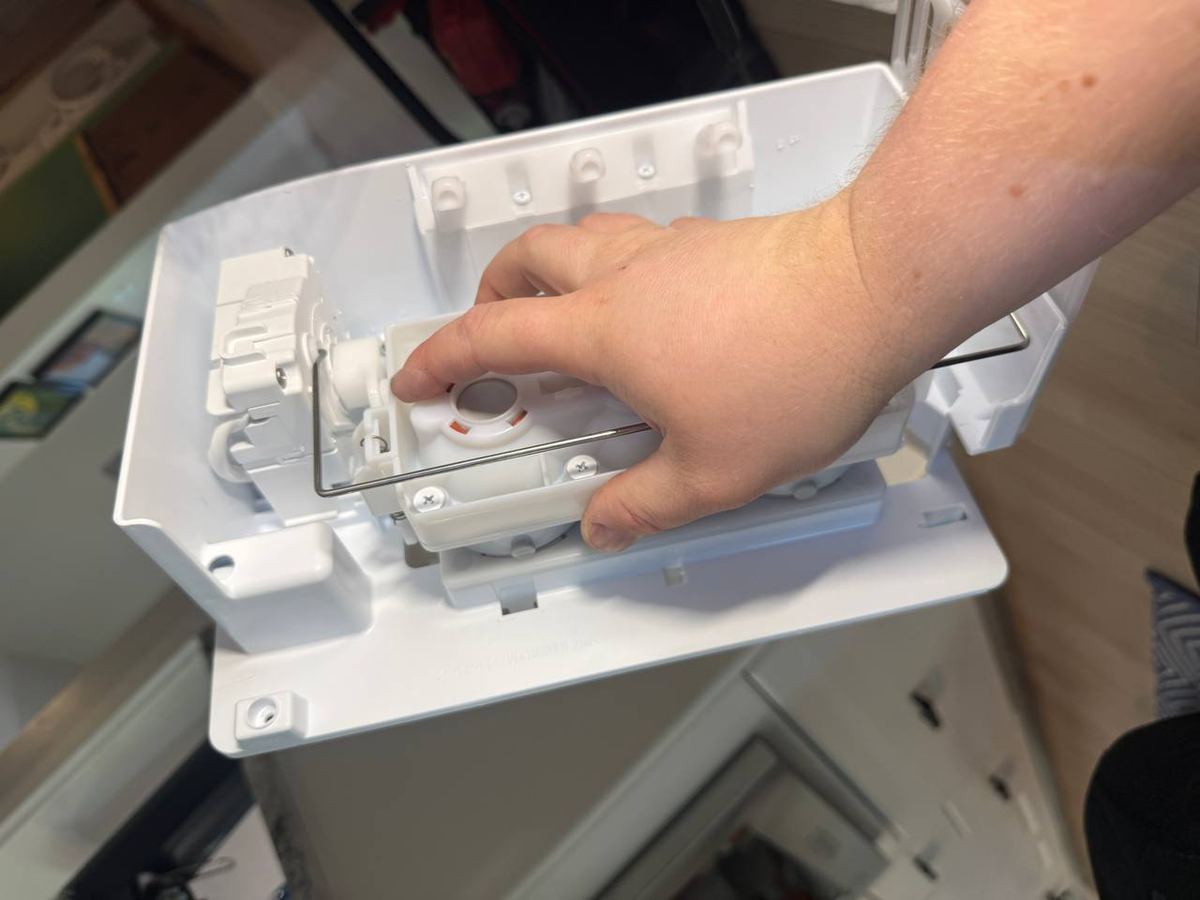
In the freezer of older side-by-sides and top-freezers from Whirlpool, Kenmore, Maytag, Amana and GE, the ice maker is a self-contained module with a wire shutoff arm. French-door models from LG, Whirlpool, KitchenAid, GE and Café often place it in the fresh-food door or ceiling, inside an insulated compartment with its own small fan and heater. Frigidaire and Electrolux use similar door bins on many models. Built-in units from Thermador, Bosch and Miele tuck the ice maker behind panels and drawers, and some larger refrigerators carry a second one in the freezer drawer.
By city
Ice makers and the water in each of our eight cities
Every cube starts as tap water, so your city shows up in the valve. Burnsville’s unsoftened 23–25 grains and Apple Valley’s 24 load inlet screens and filters fastest. Savage, much of whose water comes from Burnsville, runs about 19–21 grains; Prior Lake about 19.3; Lakeville about 18. Eagan’s hard well water leaves the same white crust around the fill cup. In Bloomington the city softens its supply to about 5 grains, so slow ice there more often traces to a filter, a kinked line or a frozen fill tube. Rosemount homes on city wells do well when someone checks the softener before blaming the filter.
Repair or replace
Fix the ice maker or the whole refrigerator?
An ice maker module, inlet valve, auger motor or fill tube heater is a modest part, so if the refrigerator itself cools well, repair is almost always the sensible path. The answer changes when the ice problem rides along with a bigger one, such as a freezer that won’t hold temperature; then we look at the whole cabinet, and if the readings point toward the compressor or refrigerant, we walk you through what that means for fixing versus replacing. Door-mounted ice compartments that keep icing over need the cause found, whether a seal, fan or heater, not just a new module. Some owners decide to shut the ice maker off, and we show you how to close its supply.
Questions
Ice maker repair questions
Why didn’t my ice maker come back after the power returned?
Some modules need a reset or a full cycle to find their starting position, and a bucket that melted and refroze can jam the auger or hold the shutoff arm up. Empty the bucket, give it a few hours, and if ice still doesn’t come, the module or valve may have taken a surge. We test both.
Will a refrigerator water filter fix hard water in Burnsville?
No. The filter traps sediment and improves taste, but it doesn’t remove the hardness behind Burnsville’s 23–25 grains, so scale still forms in the inlet valve and fill tube. A filter changed on schedule and a softener kept in salt slow the build-up. When the valve itself is crusted, replacing it is the repair.
Can you fix the ice maker in my Lakeville garage refrigerator?
Usually, but first we check whether the model was rated for a garage at all. In winter the water line and fill tube can freeze, and many makers advise turning the ice maker off in unheated spaces. We thaw and test the valve and module, then tell you whether running it through a Lakeville winter is realistic.
Do you repair standalone ice machines?
No. We repair the ice makers built into refrigerators, including the ones in freezer drawers and door compartments. Standalone ice machines, wine coolers and commercial equipment are outside our work. If the refrigerator around the ice maker has other problems, such as a warm fresh-food side or a leak, we look at those on the same visit.
Is the old saddle valve on my supply line a problem?
It can be. Older ramblers often have a self-piercing saddle valve tapped into a copper pipe, and those restrict flow, clog with mineral and sometimes drip. The valve belongs to the house plumbing rather than the refrigerator, but the technician will show you what the flow test found and whether the valve is limiting your ice.
How soon will ice come after a repair?
The first harvest usually drops within a few hours once the mold is cold, and a full bucket takes about a day. Throw out the first couple of batches, which can carry loose debris or taste of new plastic. If nothing has dropped by the next morning, call us back; the repair carries a written warranty.
Ice Maker Repair by city
Other services
Troubleshooting guides
Book the $89 diagnostic visit
Ice maker trouble begins with a $89 diagnosis; go ahead with the repair and that charge is counted inside the written price, or stop there and nothing more is owed.