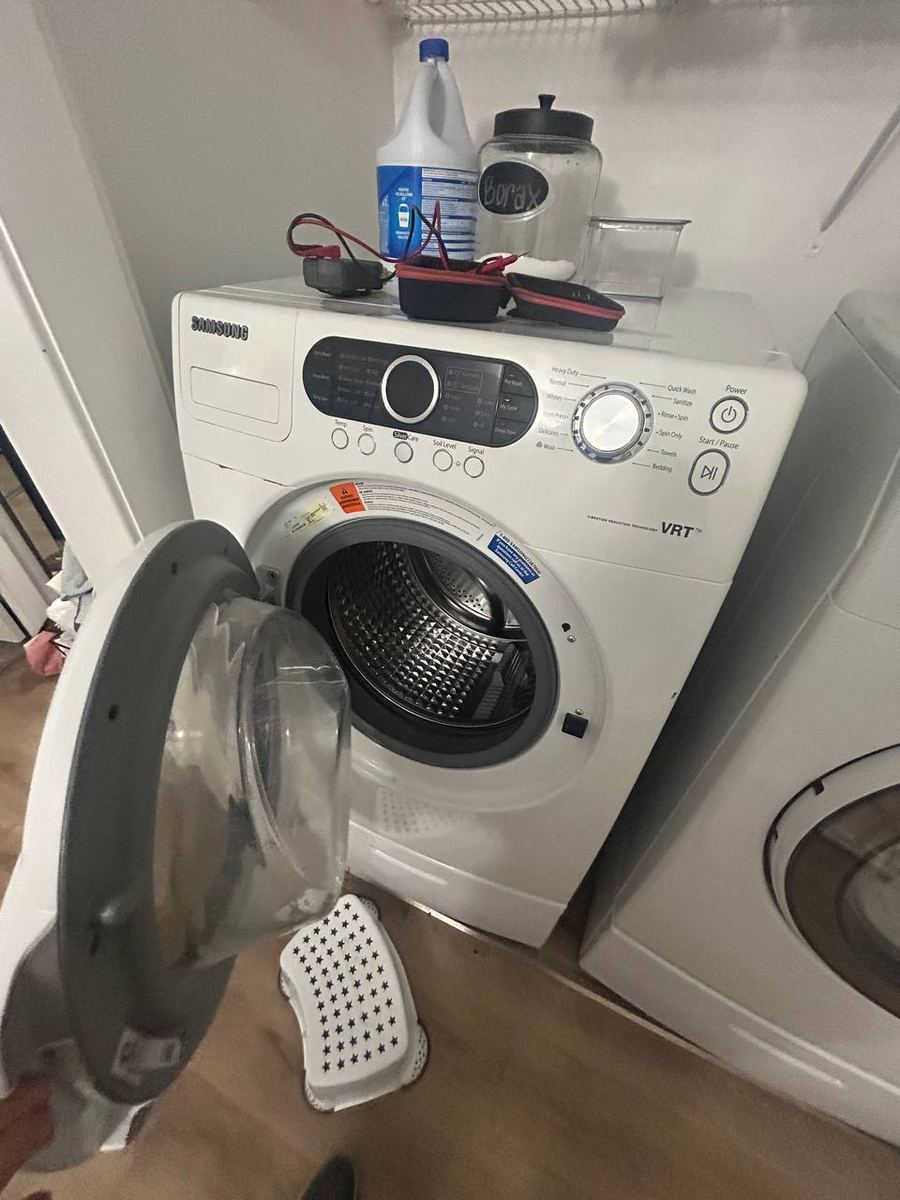
Washers · front-load, top-load, stacked
Washer repair across Burnsville and seven neighboring cities
Water standing in the drum, a door that stays locked, a spin cycle that shakes the floor. We repair front-load, top-load and stacked washers in Burnsville, Apple Valley, Eagan and the rest of the south metro, often in one visit.
- $89 diagnostic, counted inside the repair you approve
- One written price before any work begins
- Monday through Saturday, same-day when we can
- Drain and spinPumps, belts, lid locks and suspension tested
- Inlet screensHard-water grit cleared from valves and fill screens
- Stacked pairsCloset and condo units serviced where they stand
Washers
Washers in Burnsville basements, Lakeville laundry rooms and Eagan townhomes
Where a washer sits shapes how it fails and what a failure costs you. In the 1960s and 1970s ramblers and split-levels of Burnsville and Apple Valley, it usually stands on a basement slab beside a laundry tub, a floor drain and sometimes a sump pit, so a leak becomes a puddle the drain swallows. Newer houses in Lakeville and Rosemount often move the laundry upstairs near the bedrooms, where a weeping door boot or a split fill hose turns into a brown ring on the kitchen ceiling underneath. Eagan and Bloomington have a large share of townhomes and apartments, and there the machine is often a stacked pair or a compact front-loader tucked behind closet doors, so access and leveling become part of the repair itself.
Hard water drives a good share of what we see. Minerals and grit collect on the inlet valve screens until the drum fills slowly or the control throws a fill error, and detergent works harder, so owners add more and the residue builds in the door boot. Humid summers finish the job, leaving front-loaders musty. Drain trouble is the other big category. A typical scene: a front-loader in a Savage townhome stops mid-cycle with water in the drum and a drain error blinking. The technician opens the pump filter behind the lower panel and finds a dime and a baby sock wound around the impeller, clears them, meters the pump motor to make sure it survived the strain, then runs a drain-and-spin test before packing up.
Symptoms
Washer problems we fix most often
Water left in the drum
A clogged pump filter, a failed drain pump, a kinked hose or a blocked standpipe can all leave water behind. We clear the filter, meter the pump and run it on its own. If the clog sits in the house drain past the machine, we tell you so it goes to the right trade.
Agitates but won’t spin
Top-loaders usually stop spinning because of the lid switch or lid lock, the drive belt or the motor coupler. Front-loaders refuse to spin when the door lock fails, when water hasn’t fully drained or when the load can’t balance. We test each switch with the meter and watch the control’s own diagnostic mode.
Door won’t unlock
The lock stays engaged while the control senses water in the drum, so a drain failure often looks like a lock failure. When the drum is empty and the door still holds, the lock assembly or its wiring is at fault. We read the water-level sensor and meter the lock before replacing anything.
Banging or walking on spin
Worn shock absorbers on a front-loader, tired suspension rods on a top-loader, an uneven floor or shipping bolts left in a new machine will set it loose. A deep roar that grows with speed means tub bearings. We check each support, level the feet and listen to the bearings by turning the drum by hand.
Slow fill or fill error
Minerals and sediment collect on the screens inside the inlet valve, and the supply valves behind the machine are sometimes half-closed. We shut the water off, pull the hoses, clean or replace the screens, meter the valve solenoids and confirm the fill rate before calling it done.
Musty smell and dark gasket
A front-loader’s door boot holds water and detergent residue, and humid weather grows mildew in the folds. Too much soap, above all on soft water, makes it worse. We replace a torn or stained boot, clear the pump filter and explain dosing and leaving the door cracked between loads.
Brands and models
Washer brands and designs we service
Basement laundries in older ramblers still hold plenty of Whirlpool, Maytag and Kenmore top-loaders, some with agitators and some with low-profile impellers. Newer homes lean toward front-loaders from LG, Samsung, Whirlpool and Electrolux, often on pedestals and often with a steam setting. Speed Queen top-loaders turn up with owners who want simple, sturdy controls, while Bosch and Miele compact models fit stacked closets in condos and apartments. GE, Frigidaire and Amana fill out the rest, including the one-piece laundry centers built into some townhomes. The model and serial numbers sit under the lid or around the door opening.
By city
Hard water, soft water and laundry rooms across eight cities
Most of our washer calls come from hard-water cities. Burnsville’s water runs about 23–25 grains and Apple Valley’s about 24, which is why inlet screens crust and detergent struggles there. Savage, at roughly 19–21 grains, and Prior Lake, at about 19.3, show the same pattern a step milder. Lakeville tests near 18, and the city suggests setting softeners at about 14–16 grains rather than all the way down. Eagan’s well water is hard as well. Bloomington flips the problem: water softened by the city to about 5 grains means a normal detergent dose foams over and front-loaders throw suds errors. In Rosemount, check the softener before measuring detergent.
Repair or replace
Repairing a washer versus buying another
A lid switch, belt, inlet valve, door lock, set of shocks or drain pump costs far less than a new machine and usually buys years of service, so we rarely hesitate on those. The harder call is a front-loader with failed tub bearings or a corroded spider arm, because the tub has to come apart and the labor is heavy; on an older machine we will tell you plainly that replacement may make more sense. Top-loaders with a worn transmission fall somewhere between. You get the diagnosis, the written price and what we think of the machine’s overall shape, and the choice stays yours. A washer still under the maker’s warranty gets pointed back to that warranty first.
Questions
Washer repair questions
Why does my Bloomington front-loader keep throwing suds errors?
Bloomington’s city plant lime-softens its water to about 5 grains, and a normal detergent dose in soft water makes far more foam than the machine can drain. The pressure sensor reads the foam as water and stops the cycle. Use a fraction of the cap, and know that a home softener on top of city-softened water is usually unnecessary.
Can I keep using a washer that leaks a little?
We would not. Small leaks grow, and the source matters: a fill hose, the door boot, the drain pump seal or the tub seal. In an upstairs laundry room the water finds the ceiling below before you notice it. Close the supply valves behind the machine and leave it alone until the leak is found.
Can you look at the dryer on the same visit?
Yes. Tick the second-appliance box on the form or mention it on the call, and we take $10 off the diagnostic for that other machine. Washers and dryers often share a cause anyway: a washer that spins poorly sends heavy, wet loads to the dryer, which then gets blamed for running long.
My Apple Valley washer fills slowly. Is it water pressure?
Sometimes, but at about 24 grains of hardness Apple Valley water is tough on inlet screens, and a half-closed supply valve is common too. If your softener has run out of salt, the screens load up faster. The technician checks the valves, cleans or replaces the screens and meters the inlet solenoids.
Do you repair stacked units in condos and apartments?
Yes. A stacked washer and dryer can often be serviced in place, and when the job needs it we separate the pair and set it back afterward. Tell us about elevator rules, parking and any building access codes when you book, so the visit starts on time and the hallway stays clear.
What should I do before the technician arrives?
Make room around the washer so the technician can pull it out, and have towels handy if water is still in the drum. Don’t remove panels or force the door. Write down any error code on the display and read us the model number off the sticker, which lets us bring the right parts the first time.
Washer Repair by city
Other services
Troubleshooting guides
Book the $89 diagnostic visit
For a washer, $89 covers the meter work and the diagnosis, and when you approve the repair that amount is already inside the written price instead of added to it.