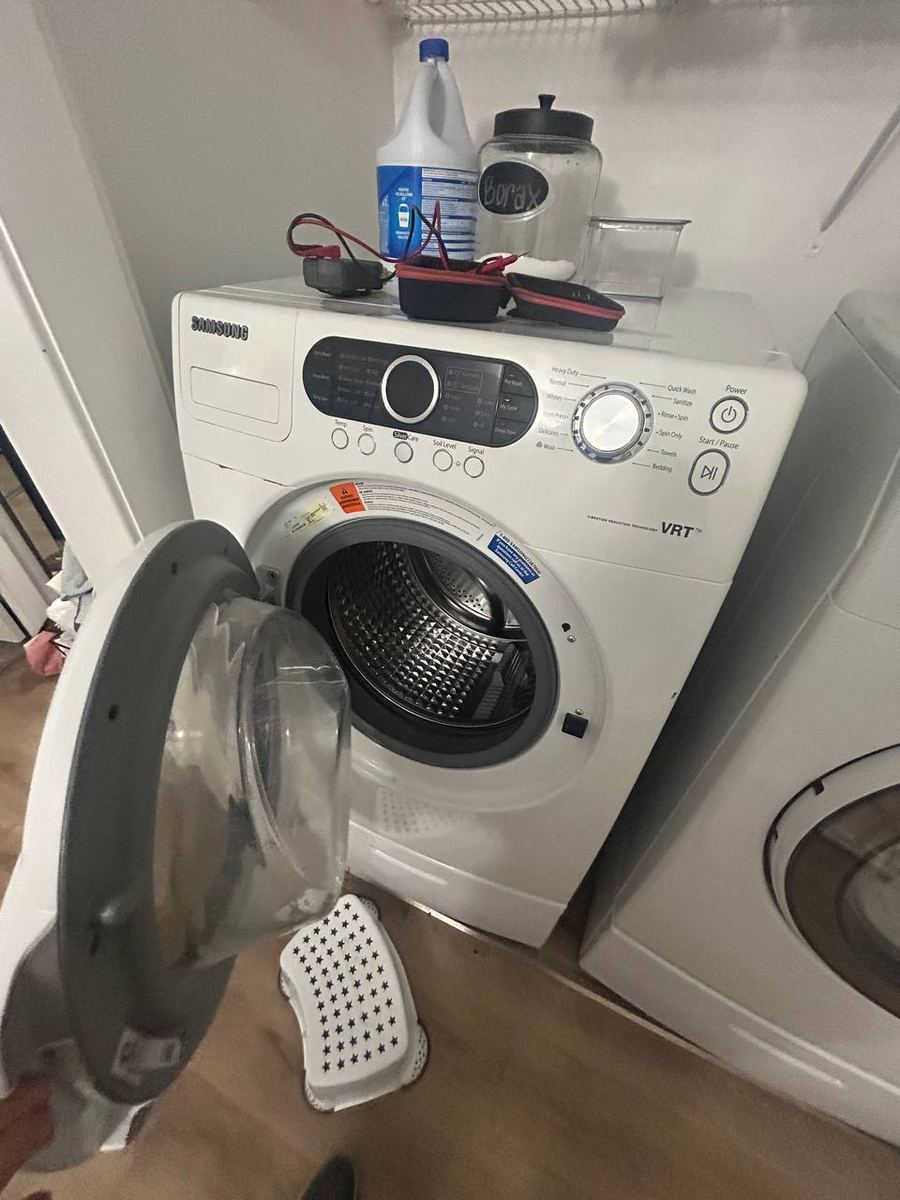
Troubleshooting · washers · draining
Washer not draining in Savage: why the water stays put
The cycle stalls, the door stays locked and gray water sits in the drum. In Savage laundry rooms the culprit is usually a clog, excess suds or a worn drain pump, and a few checks narrow it down.
- $89 diagnostic, counted inside the repair you approve
- One written price before any work begins
- Monday through Saturday, same-day when we can
- Locked doorNormal while water remains inside the drum
- Common culpritSocks, coins and hair ties in the pump
- Savage waterAbout 19 to 21 grains per gallon
Safe checks first
What you can safely check first
- Make sure the cycle truly ended; soak, rinse hold and delay settings can pause a washer with water inside on purpose.
- Pick drain and spin by itself and listen near the base; a hum, a whir or silence each tells us something.
- Look behind the washer for a kinked drain hose, especially if someone recently nudged the machine back toward the wall.
- Watch the standpipe, laundry tub or floor drain; if water backs up there, the house drain is slow, not the washer.
- If your front-loader's manual shows an owner pump filter behind a small access door, clean it as described, towels ready.
- Use only HE detergent measured to the line; a drum full of foam can keep a washer from draining at all.
Likely causes
Why washers hold water, and what our technician checks
| Likely cause | What points to it | What the technician tests |
|---|---|---|
| Clogged pump filter or jammed impeller | Pump hums, water barely moves; small items gone missing | Pump inlet and impeller for debris, drain time on a test cycle |
| Failed drain pump | Silence during drain, a drain error code on the display | Pump winding resistance and voltage at the pump during a drain call |
| Kinked or blocked drain hose | Slow drain, hose crushed behind the machine | Hose path, standpipe height and how fast the house drain accepts water |
| Oversudsing from detergent | Foam in the window, extra rinses, a suds or drain code | Detergent type and dose, pressure sensor reading, a test rinse with no detergent |
| Lid switch, door lock or control | Cycle halts before draining, lock or lid code showing | Lock and switch continuity, control output to the pump, stored error history |
How it works
How a washer gets rid of its water
At the end of the wash and again after each rinse, the control switches on the drain pump in the bottom of the cabinet. The pump lifts water up the drain hose, which hooks into a standpipe, laundry tub or floor drain, while a pressure sensor watches the level fall. Only when that sensor reports an empty tub does the control let the spin begin, and the lid or door lock stays engaged the whole time. Front-loaders usually trap stray items in a pump filter near the floor. Many top-loaders have no such filter, so anything that slips past the basket heads straight to the pump. On some older top-loaders the main motor drove the pump; nearly every newer machine uses a separate electric pump.
Most drain failures start with something small. A sock, a coin, a bra wire or a hair tie lodges in the pump inlet and stops the impeller; the pump hums against it, overheats and eventually burns out a winding. Pet hair and lint mat in the filter. Overdosed detergent and fabric softener leave a gray sludge in the sump and hose, and hard-water minerals stiffen that sludge over time. Foam is a cause on its own, because many front-loaders pause to break down suds before they will pump out. Hoses kink when a washer walks during spin on an uneven floor. And sometimes the washer is fine while the standpipe or floor drain is slow, which makes it a plumbing matter.
Minnesota angle
Savage water, townhome laundry and basement drains
Savage water runs about 19 to 21 grains per gallon, a blend of supply bought from Burnsville, including filtered quarry water, and the city's own wells. Hard water nudges people toward bigger detergent doses, and that is where suds and sump sludge begin. Most Savage homes went up between 1980 and 2009, with a good share of townhomes where the laundry sits on a main or upper floor, so a stuck drain is more than a basement nuisance. Basement laundries here often share space with a floor drain and sump pit, and a slow house drain shows up there first. An outage like the overnight storms of September 2021 can strand a washer mid-cycle with water locked inside.
When to call
Time to book: signs the drain needs a technician
Book a technician if water stays in the drum after a drain-and-spin cycle with the hose straight and the filter clean, if the pump hums without moving water, or if the same drain code keeps coming back. Booking through the online form takes up to $15 off the repair. The $89 diagnostic is built into whatever repair price you approve; turn the repair down and $89 is the full bill.
Book online · up to $15 offQuestions
Washer not draining: questions
Should I force open a washer door that is locked with water inside?
No. The lock stays engaged on purpose while the control senses water, and prying it can snap the latch and dump the drum onto the floor. Try one drain-and-spin cycle. If the water stays, leave the door shut and book a visit; our technician removes the water before testing the pump, the lock and the hose.
Why does my washer drain slowly but eventually finish?
A sluggish drain usually means a partial blockage: debris in the pump filter or impeller, sludge in the hose, or a standpipe that cannot swallow water fast enough. A pump with worn bearings can also lose force. The technician times the drain, checks the pump and hose, and tells you plainly if the slowdown is in the house plumbing, which belongs to a plumber.
Can the wrong detergent stop a washer from draining?
Yes. Regular detergent, or too much HE detergent, whips up foam that front-loaders detect, and many will pause, add rinses or hold off pumping until it settles. With Savage's hard water it is tempting to pour in extra, but measuring to the line works better. If foam is not the issue, the technician moves on to the pump and the pressure sensor.
My washer empties into a laundry tub that overflows. Is the washer at fault?
Usually not. If the tub or standpipe overflows while the washer pumps, the washer is doing its job and the house drain downstream is slow, often from lint. Our technician can confirm the pump output and the hose, then tell you it is a plumbing problem rather than an appliance part, so you are not paying for a washer repair that would not help.
Do you repair stacked washers in Savage townhomes?
Yes. Stacked units and laundry closets are common in Savage townhomes, and we work on them in place when the space allows it. Mention on the call or in the form that the washer is stacked and how the closet is laid out, so the technician arrives ready for tight access and for emptying the drum before any testing.
Book the $89 diagnostic visit
A washer full of water can wait behind a closed door. The technician empties it, tests the pump, lock and pressure sensor on the meter, and quotes one written price before any repair.